
lernen.svg

Physics at Georgianum

Measuring, interpreting and shaping the world together

Why does a touchscreen respond to fingers but not gloves? Why does hot asphalt shimmer like a puddle of water? And why are sunrises on Mars bluish? In physics lessons at Georgianum, we get to the bottom of such questions.

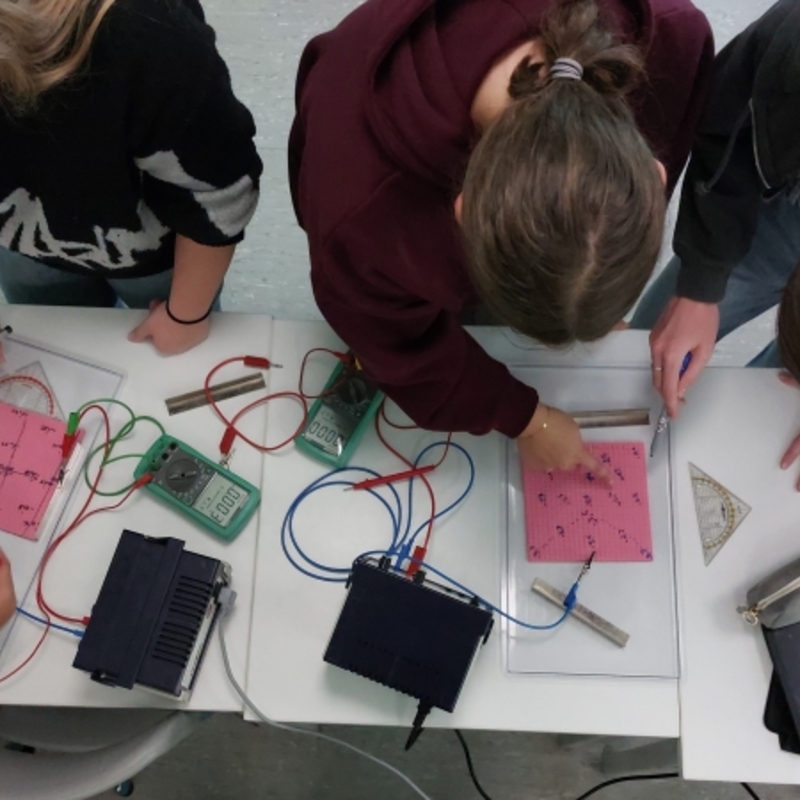
From the outset, the focus is on joint experimentation and scientific work. Everyone can contribute their experiences, raise new questions and bring in phenomena they have observed themselves in nature, medicine and space. Together, we analyse complex relationships and at the same time learn to back them up with physical arguments.

Let's work together to better understand the world and critically question it in order to shape a promising future.

Key areas of physics

Lower secondary education

(Years 5–10)

Hours per week

  • Year 5: 2 hours/week
  • Year 7: 2 hours/week (block teaching)
  • Year 8: 2 hours/week
  • Year 9: 2 hours/week (block teaching)
  • Year 10: 2 hours/week

Contents

  • Magnetism
  • Electric circuits
  • Optics
  • Energy transfer
  • Electrical
  • Motion-mass-force
  • Atomic and nuclear physics

Additional cross-curricular offerings

  • STEM profile (Year 5)
  • Youth Research Club
  • Voluntary participation in competitions

Upper secondary education

(Years 11–13)

From introductory phase (Year 11)

As a science subject with 2 hours per week

In the qualification phase (Year 12/13)

  • As a basic course (3 hours per week)
  • As an advanced course (5 hours per week)

A-level examination

As a written or oral examination subject (basic or advanced level)
Contents

  • Dynamics
  • Electricity
  • Oscillations and waves
  • Quantum objects
  • Atomic shell and atomic nucleus
  • Electromagnetism

What else?

20250910_125221-.jpg

Regular events and competitions

  • Physics in Advent (PiA): Advent calendar with small experiments
  • International Physics Olympiad (IPhO): theoretical and experimental tasks
  • Nationwide Physics Competition of the MNU: independently planning, documenting and conducting experiments

Teachers of physics

leh-gro.jpg

Sebastian Grosse

Fachobmann Physik

Kyra Berends

Christina Grote

leh-hee.jpg

Kathrin Heese

leh-hmg.jpg

Ingrid Helming

leh-kmr.jpg

Stefan Kemmer

Theresa Kemmer

leh-lrs.jpg

Eva-Maria Lammers

leh-pri.jpg

Anne Prins

leh-siv.jpg

Maresa Sievering