



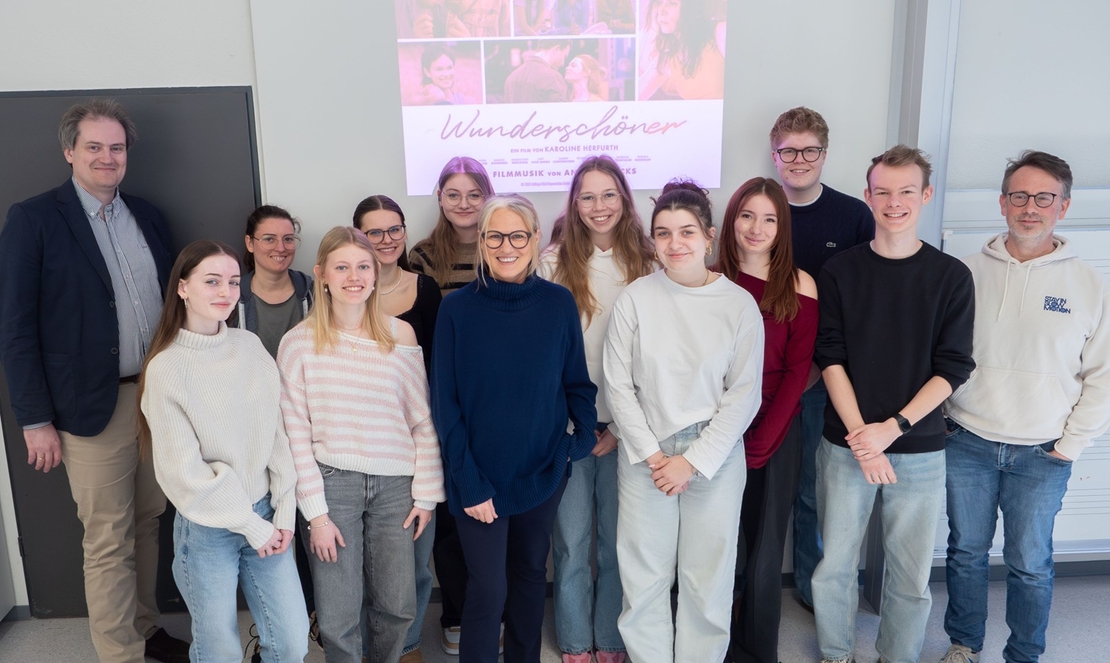
On 18 March, we had the special opportunity to welcome renowned film composer Annette Focks to our Year 12 music class. As we had previously seen the film Wunderschöner, for which she composed the soundtrack, we were able to ask specific questions about her work and gain exciting insights into her profession.
How is film music created? Focks explained that she usually begins her work with the screenplay. This serves as the basis for her initial musical ideas. She then works closely with the director and the editing team to determine which music best suits the mood of the film. This involves a lot of experimentation – pieces of music are tried out, discarded or adapted until they harmonise perfectly with the images.
We found it particularly exciting that she often receives individual film scenes as so-called Quicktimes in the studio. These short video clips help her to compose the music in sync with the images. In most cases, the music is created after the film. However, there are exceptions: for a Swedish film she worked on, the music was composed first and the scenes were then shot specifically for it.
During our conversation, it quickly became clear that working as a film composer involves a lot of time pressure. Focks usually only has one to two months to compose the entire score for a film. Sometimes even less, if a film has to be released sooner due to competition. Especially when editing takes longer than planned, she often has little time to finish everything on time.
One of the most exciting insights for us was Focks' approach to film music. She doesn't like it when music overemphasises every single moment in a film – a style known as Mickey Mousing. She much prefers to compose music that has a subtle effect, enhancing emotions without being intrusive. "Music that you don't consciously perceive, but that still has an effect on you" – that's how she describes her preferred style of composition. She is particularly fascinated by this subtle form of "invisible manipulation".
One question that particularly interested us was the use of the song Stand by Me in Wunderschöner – and why it is a cover version. Focks explained that she is not responsible for selecting and licensing songs. This task is performed by the music supervisor, who must acquire the rights for specific songs. However, not all songs are available for purchase – if the original version cannot be used, musicians are hired to create their own interpretation of the song.
Annette Focks spoke very honestly about the uncertainties of her profession. She never had an agent – either she got a call or she didn't. It took her a long time to establish herself in the film industry. And even today, there are periods when she doesn't get any requests. Her recipe for success? Doing a good job. Because in the film world, word of quality gets around – directors and producers recommend composers to each other. When asked about competitive pressure, she replied that she does not compare herself to others. Instead, she sees herself as a climber who climbs for herself, without focusing on the achievements of others. Nevertheless, self-doubt is part of life for her: "I always feel like I can't do enough. But so what? I can't do everything."
Of course, we also wanted to know which films she enjoyed working on the most. Her answer was surprising: "I enjoyed an infinite number of films. Maybe 1% I didn't." She particularly fondly remembers her work on the films Ostwind and Krabat.
Focks herself plays several instruments, including the organ, piano and trumpet. When composing, she usually uses a grand piano and writes the notes by hand – a very traditional way of working that helps her to express herself creatively.
Annette Focks' visit was an inspiring experience for us. Not only did we learn a lot about film music, but also about how important it is to follow your own path and not let doubts or competitive pressure discourage you. We were deeply impressed by her passion for music and her open, honest manner – and who knows, maybe she even motivated some of us to try our hand at film music ourselves.
Text: Eva Völk