


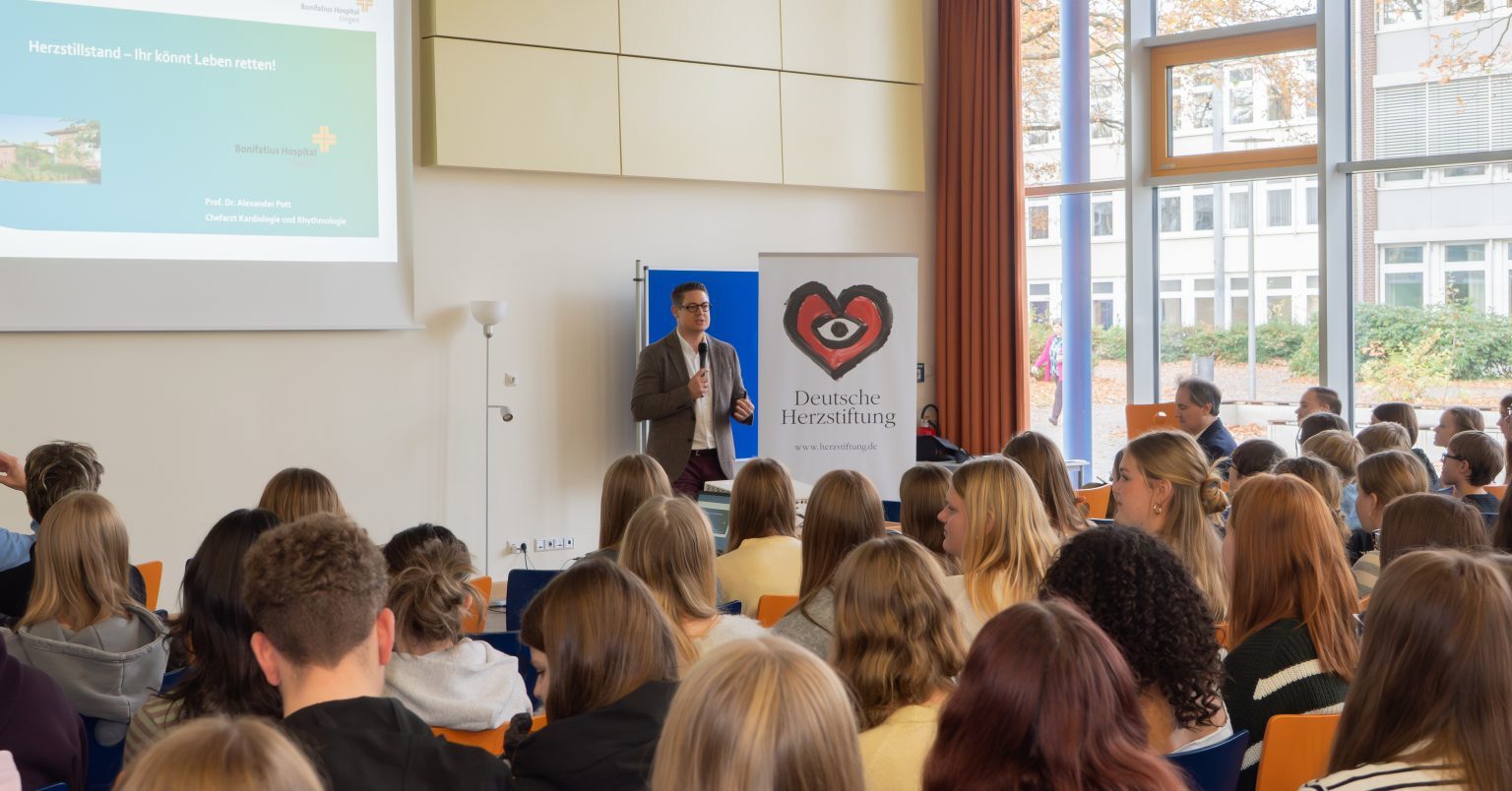
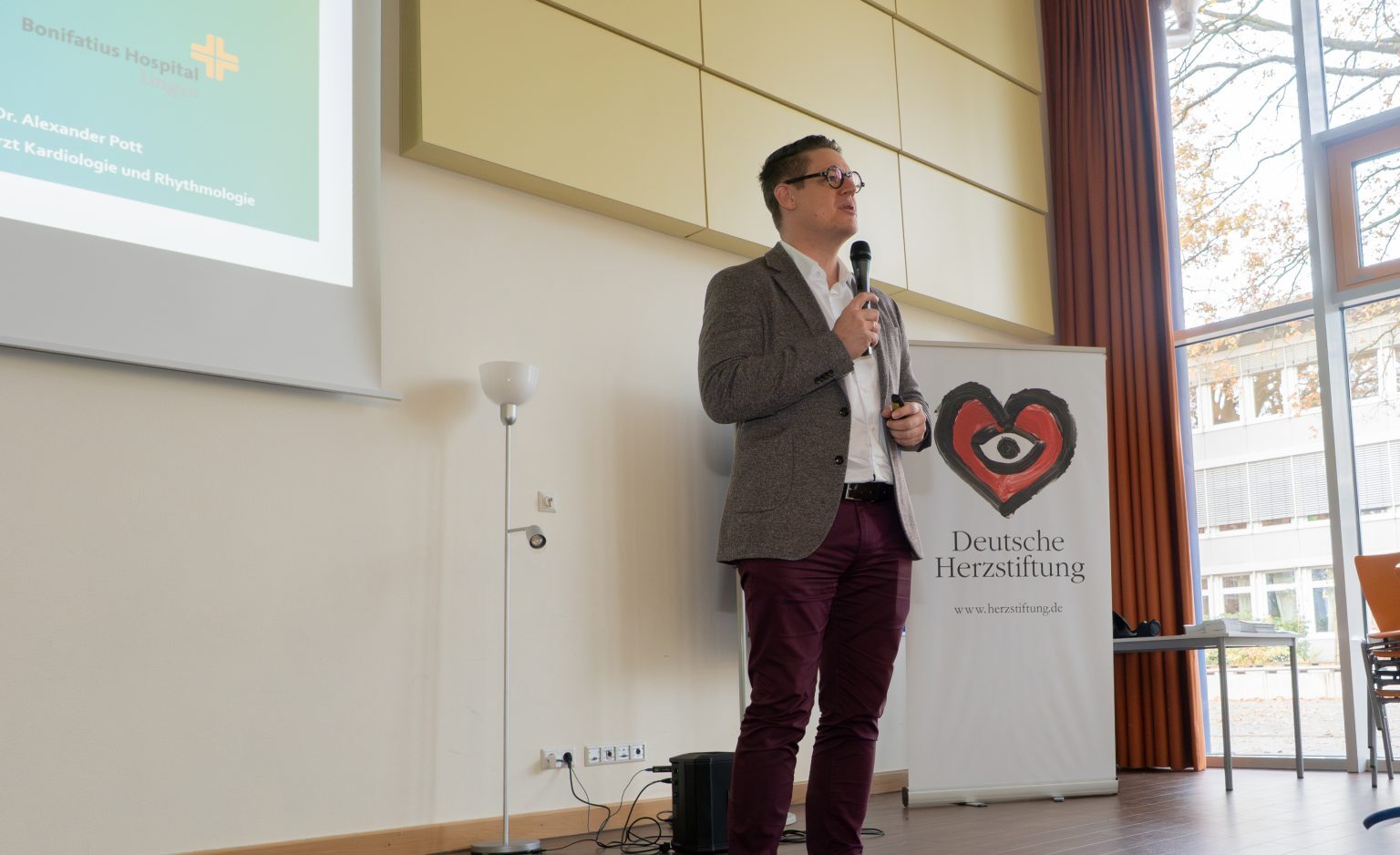
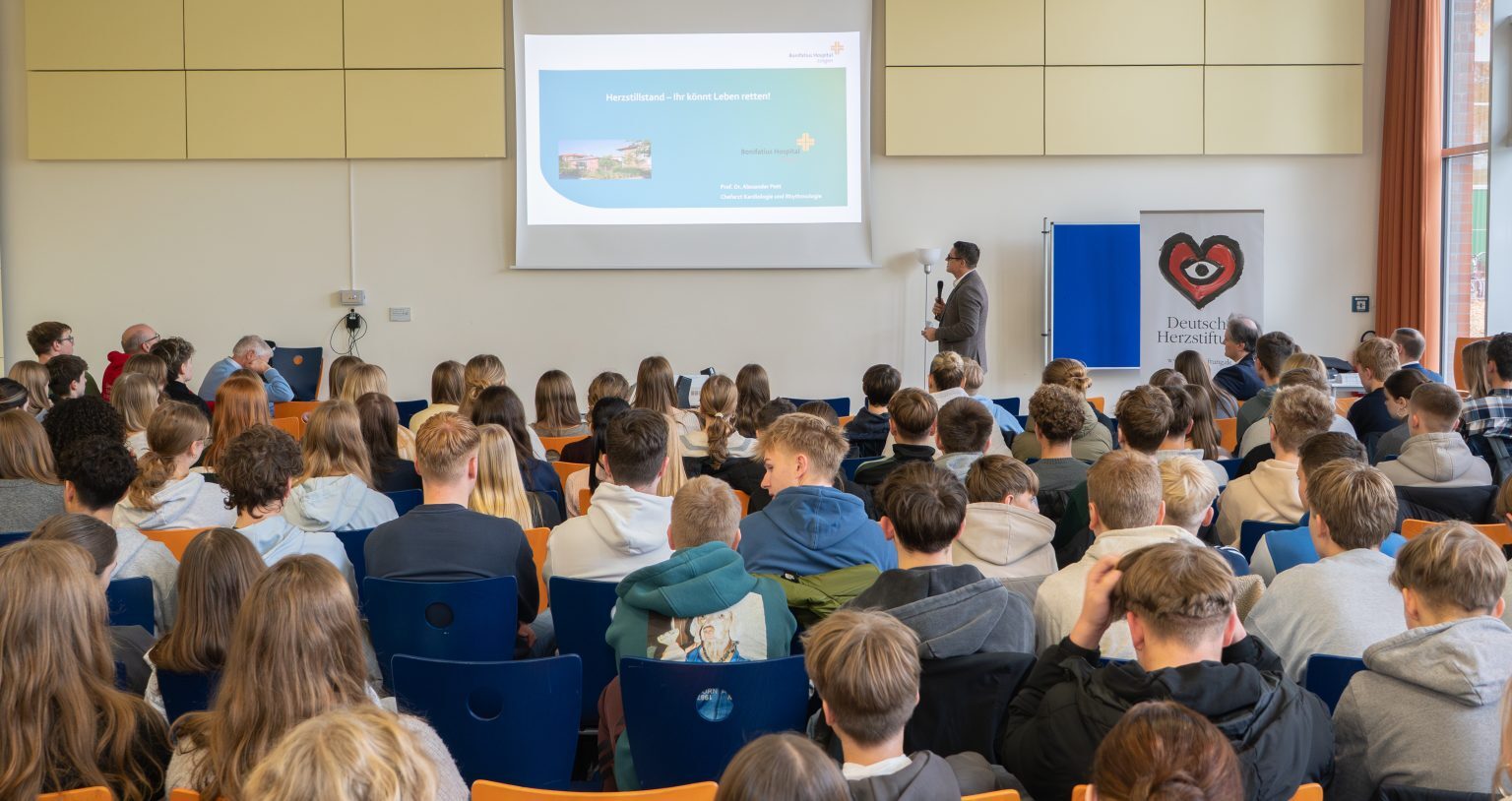
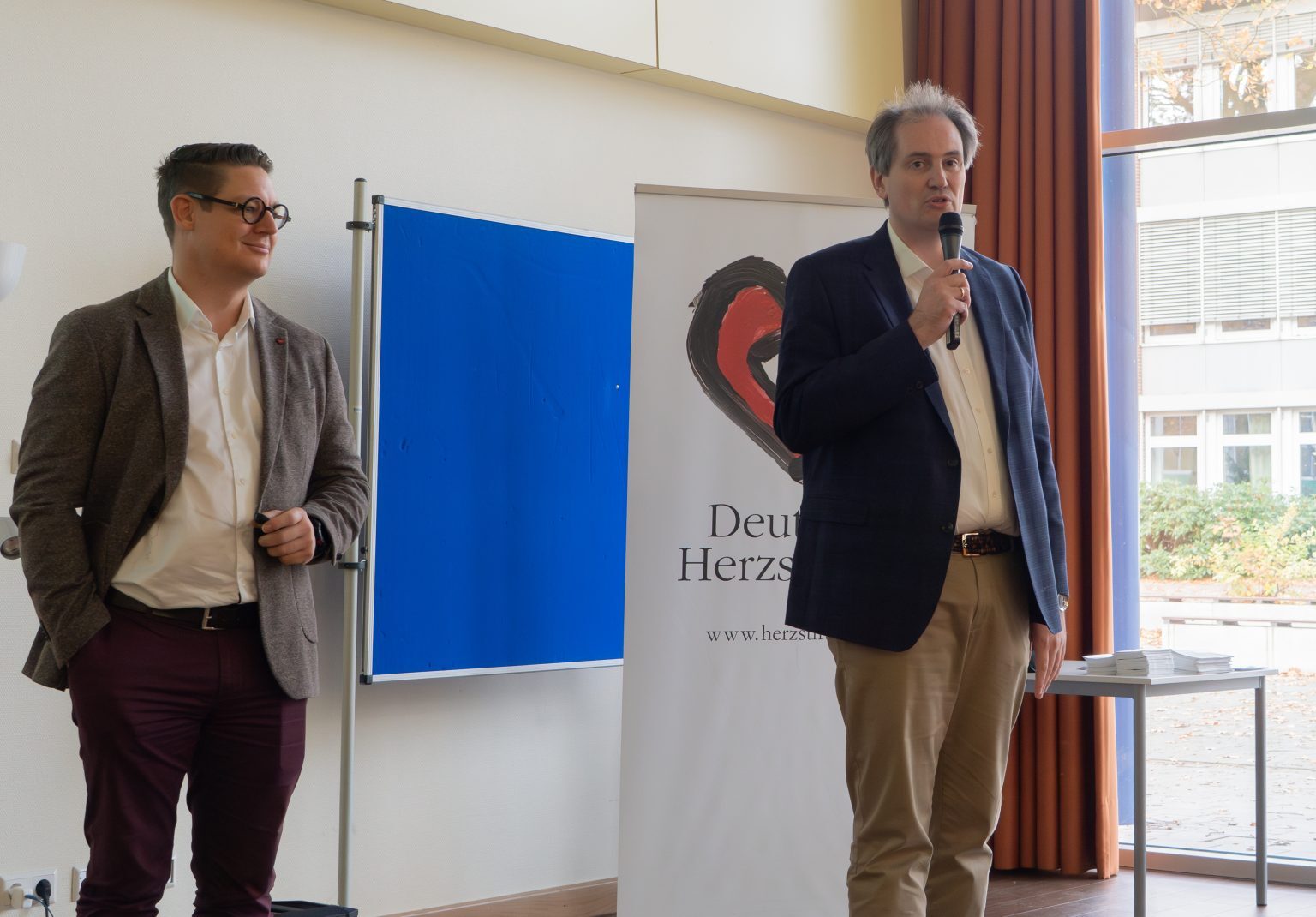
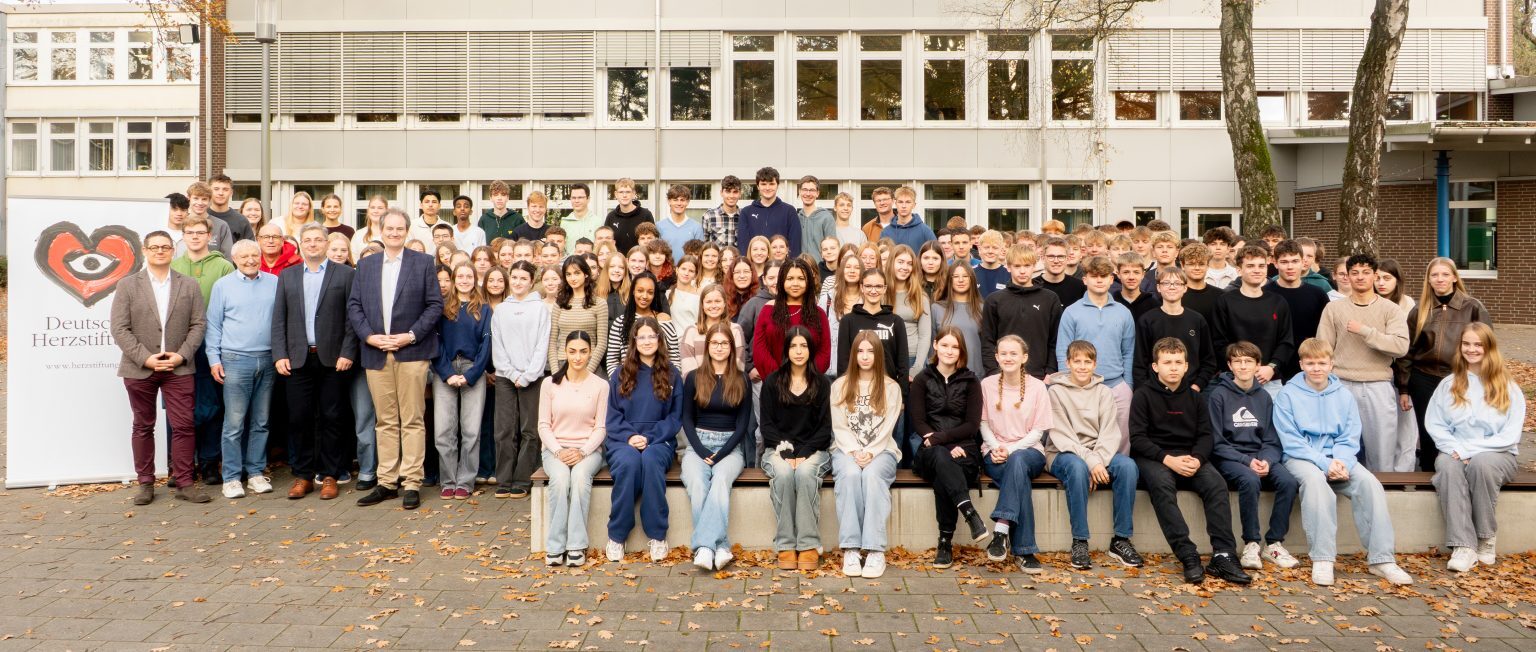
Professor Alexander Pott, Chief Physician of Cardiology at Bonifatius Hospital in Lingen, launches the "Herzensretter Bronze" (Bronze Heart Saver) project at Georgianum Grammar School in Lingen, which is being implemented under the patronage of the German Heart Foundation and in cooperation with the DLRG (German Life Saving Association), Lingen branch.
In his speech, Prof. Pott, a member of the German Heart Foundation's scientific advisory board, used vivid case studies and scientific facts to raise awareness among his audience about the topic of resuscitation and to get the students excited about the upcoming "Bronze Heart Saver" project.
Under the patronage and with financial support from the German Heart Foundation, the Bronze Heart Saver project can be implemented at the Georgianum Lingen Grammar School for Year 10 in cooperation with the DLRG Lingen. Prof. Dr. Pott and Mr Hermann Hesse, honorary representative of the German Heart Foundation for the Emsland and Grafschaft Bentheim regions, were invited as representatives of the German Heart Foundation.
In his welcoming speech, Mr Lucas Sieberg emphasised the great importance of this project for the Georgianum Grammar School. He went on to say that he hoped the pupils would never find themselves in a situation where resuscitation was necessary. "But if this should happen, I hope that you will be in capable hands so that you can be helped. And I hope that, as first responders, you will be trained to help courageously and confidently," Sieberg continued. "Because as heart savers, you will learn to act decisively in an emergency. You will learn how to save lives by taking vital measures – and perhaps one day you will be the ones who make the difference at the crucial moment."
Mr Jansen is the branch manager of the DLRG (Lingen local group) and is already well known to the pupils. In Year 8, he led the first aid project "First aid with self-protection content". The Year 10 pupils already completed this with him two years ago.
In further remarks, Prof. Pott emphasised the importance of lay resuscitation: "I know of no modern medication or other modern medical method that is so highly effective at virtually no cost. Lay resuscitation can be a real game changer in modern medicine when it comes to saving lives." In this context, he recalled milestones in medical history, such as the discoveries of Alexander Flemming and Rodert Koch.
"When performing cardiac resuscitation, it is primarily important to act," said Pott. "Those providing assistance need courage to carry out the measures." Mr Jansen supported this statement: "Check – call – press – don't stop pressing. That's the slogan that should be internalised to remember the order in which the measures should be taken."
When performing lay resuscitation, it is important to note that chest compressions are crucial for the further course of the emergency. Chest compressions should be performed at a high frequency of approximately 100–120 times per minute. Well-known songs such as "Stayin' Alive", "Yellow Submarine" or "Happy Birthday" have a suitable rhythm and can help you choose the right frequency. Ventilation is not necessary at first, as there is still enough oxygen in the patient's blood for approx. 5-10 minutes. In addition, chest compressions also cause some air exchange in the lungs, which should be sufficient for the brain to continue to receive some oxygen. The conclusion to be drawn from this is: have the courage to compress, and do so to a depth of 5-6 cm. Of course, the emergency services must also be informed, who in Lingen should usually arrive after approx. 8 to 10 minutes.
In a further step, Prof. Pott explained the theory behind the appearance of sudden cardiac death. He presented heart attacks, various cardiac arrhythmias and heart failure in a vivid and tangible way, using interesting case studies as possible causes of sudden cardiac death. The distinction between dilated and hypertrophic cardiomyopathies rounded off this theoretical part in a very concrete manner.
Prof. Pott has been working on this topic for many years. He brings a wealth of experience from his previous position at the University Heart Centre in Ulm, where his scientific focus was on arrhythmias and genetic heart diseases; there, he headed the consultation hours for genetic heart diseases and cared for numerous young people with an increased risk of sudden cardiac death.
He also explained that modern methods can be used to diagnose and treat clinical pictures. For example, an ECG is mandatory. Depending on the diagnosis, further examinations may follow. Mr Hesse gave an impressive and gripping account of his personal experiences. He reported on a cardiac catheterisation examination. His appeal to the students was: "Never smoke, eat a balanced diet and exercise. First aid with the courage to act is cool and can save so many lives."
Should it be necessary to use a defibrillator in an emergency, the Georgianum is very well equipped for this. "There are now four defibrillators at the Georgianum," reports Dr Kaufhold. "The defibrillators are easily accessible during school hours. They are located in central locations: in the school office, in front of the staff room, in the sports hall and in front of the swimming pool, and in the changing room building of the outdoor sports facility." In this context, Dr Kaufhold also outlined his newly developed first aid concept for the Georgianum grammar school. In the course of this reorganisation, he also came up with the idea of reviving the school medical service, which he has been promoting ever since. This was quickly followed by the idea of better integrating first aid into everyday school life, in particular the topic of resuscitation measures, which – once practised – can save lives. Through cooperation with the DLRG, the German Heart Foundation and Prof. Dr. Pott, his idea has developed into a comprehensive concept that ranges from training as part of the school medical service to lifeguard training and a seminar course in cardiovascular medicine, part of which takes place in the cardiology department of the Bonifatius Hospital in Lingen.
In conclusion, Mr Sieberg expressed his gratitude for the excellent technical foundation provided by Prof. Pott's lecture for the heart rescuer course. "It will now be easier for the pupils to understand the processes involved in resuscitation and to grasp the extraordinary importance of resuscitation measures. On this basis, we can now start learning resuscitation in a very practical way next week," said Sieberg, emphasising the importance of the introductory event.
The Bronze Heart Saver project for Year 10 rounds off the first aid qualification programme in a meaningful way. The Georgianum Grammar School works very closely with the DLRG Lingen in this area. In addition to the Bronze Heart Saver project, there has been an annual first aid project for Year 8 (first aid with self-protection content) for several years. During this project, pupils spend a morning (6 teaching units) learning about first aid in special emergency situations. In addition, first aid courses are offered annually. Furthermore, pupils from Year 10 onwards can participate in the school's first aid service. The school first aid service is closely supervised and co-organised by the DLRG. The DLRG is responsible for training the school first aiders to become medical assistants (SAN A). Since this school year, the Georgianum Grammar School has also been participating in the Björn Steiger Foundation's Herzsicher in der Schule (Heart Safe at School) project (from Year 7 onwards). Around 30 teachers have been trained as multipliers for this project during this school year.
Text: Marc Kaufhold, photos: Stefan Roters.