


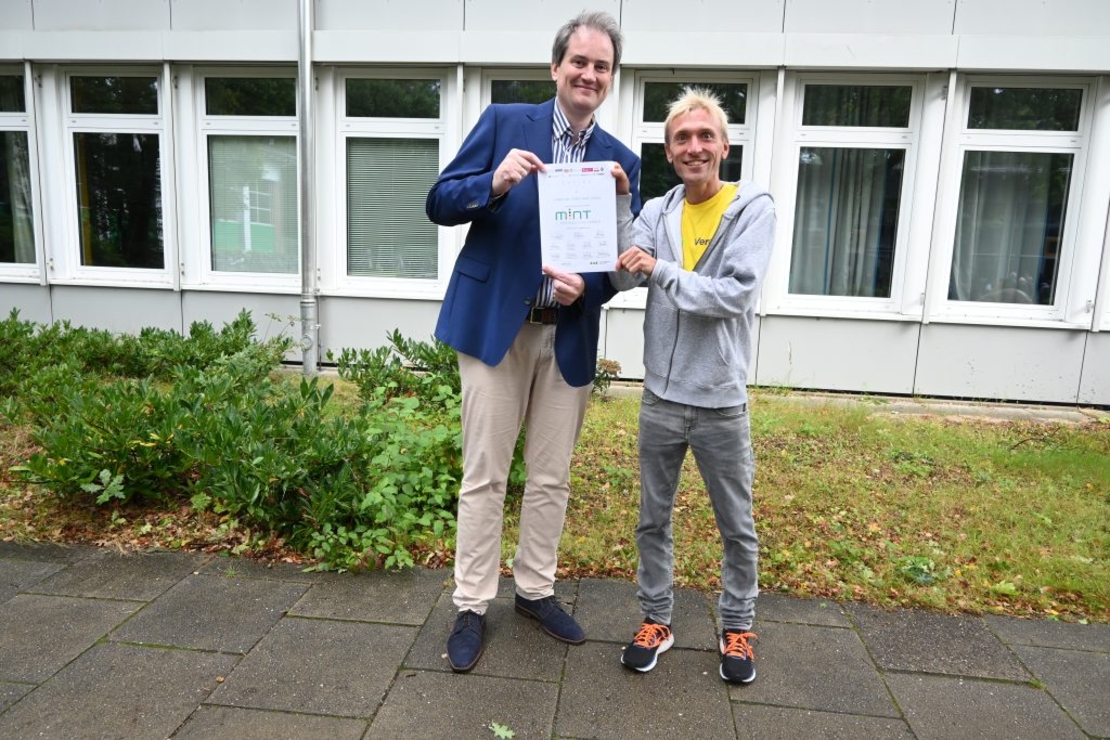
The school community is proud of the honour. "We are delighted to receive this award, as it recognises the tremendous commitment of our colleagues in the STEM field as well as the curiosity and enthusiasm of our students," said headmaster Lucas Sieberg.
The Georgianum Grammar School received the award in September 2025 for the third time after 2019 and 2022. This means that the school in Lingen has been STEM-friendly for six years. And there are good reasons for this. At the Georgianum, mathematics, computer science, natural sciences and technology are given high priority, which is reflected in numerous activities.
In the field of mathematics, the school offers students in-depth insights into the wonderful world of mathematics through the mathematics club, the revolving door model for mathematics and participation in various mathematics competitions, in addition to normal lessons. Club leader Martin Glosemeyer is delighted: "In the club, we promote problem-solving skills by focusing on valuable heuristics (problem-solving strategies). Cool tasks from the fields of arithmetic, logic, number theory, algebra, analysis, geometry, combinatorics and stochastics show how much fun mathematics can be. With over 30 registrations, the club is booming like never before." The children can also benefit from the experience of Jaira Hibbel, who runs the club together with Glosemeyer. Hibbel has enjoyed great success in numerous mathematics competitions. Most recently, she won the bronze medal at the state competition in Göttingen. A new development at the Georgianum in the last three years is the revolving door model for mathematics. In six double lessons, gifted pupils from years 5 and 6 are taken out of their normal mathematics lessons and taught separately in order to teach them more advanced aspects of mathematics. This prepares the pupils even better for the numerous competitions. "The revolving door model for mathematics is an important component of our gifted education programme. We want to give our pupils the opportunity to develop their particular strengths and experience the joy of in-depth thinking. In this way, we not only promote their mathematical skills, but also their personal development," says Siebergn. This hausarzt-roethenbach.de idea will be extended to Years 7 and 8 this school year.
In the field of computer science and technology, the Georgianum has regularly participated in the Informatik-Biber competition since the last award ceremony and has a maker club. In the maker club, students can build a wide variety of things, mostly electronic. This involves programming, designing and testing. Stefan Felschen heads the club and is delighted with the developments in the field of computer science. "Working with newer technologies and possibilities such as 3D printing, VR glasses or laser cutters, and the opportunity to create something tangible in combination with conventional tools, is something the pupils particularly enjoy."
In the natural sciences, students can develop their skills in the environmental club. The Georgianum also regularly participates in competitions in the fields of biology and chemistry.
And the Georgianum will soon be participating in Jugend forscht (Youth Researches) for the first time. Since the beginning of this school year, teachers Maresa Sievering, Sebastian Grosse, Anne Doleski and Martin Glosemeyer have been offering a Jugend forscht club where students can plan and carry out their own research projects in the STEM field.
To give students the opportunity to get to know all STEM subjects well right from the start, the Georgianum has set up the STEM profile, in which fifth-graders have one extra hour of lessons and can gain insights into the various STEM areas.
This makes Georgianum more than just STEM-friendly.
Text: Martin Glosemeyer, Image: Reinhard Albers