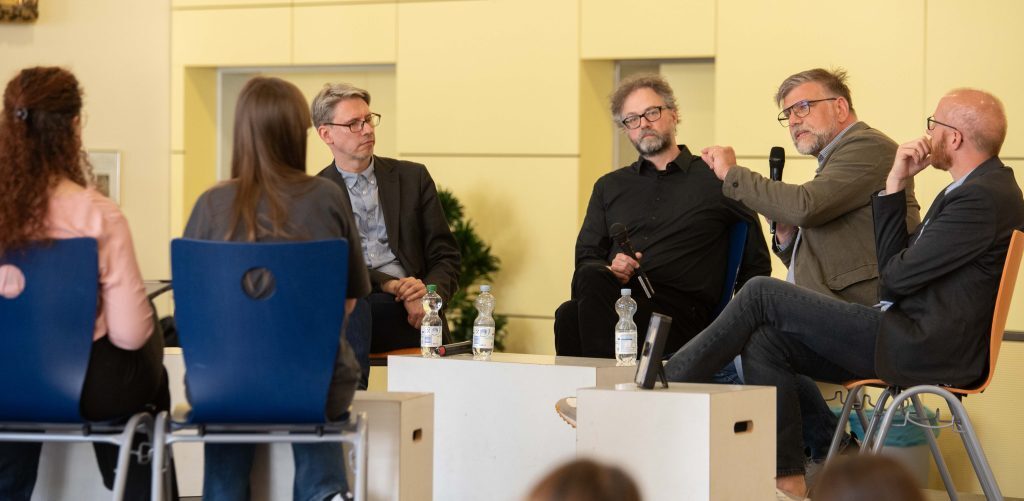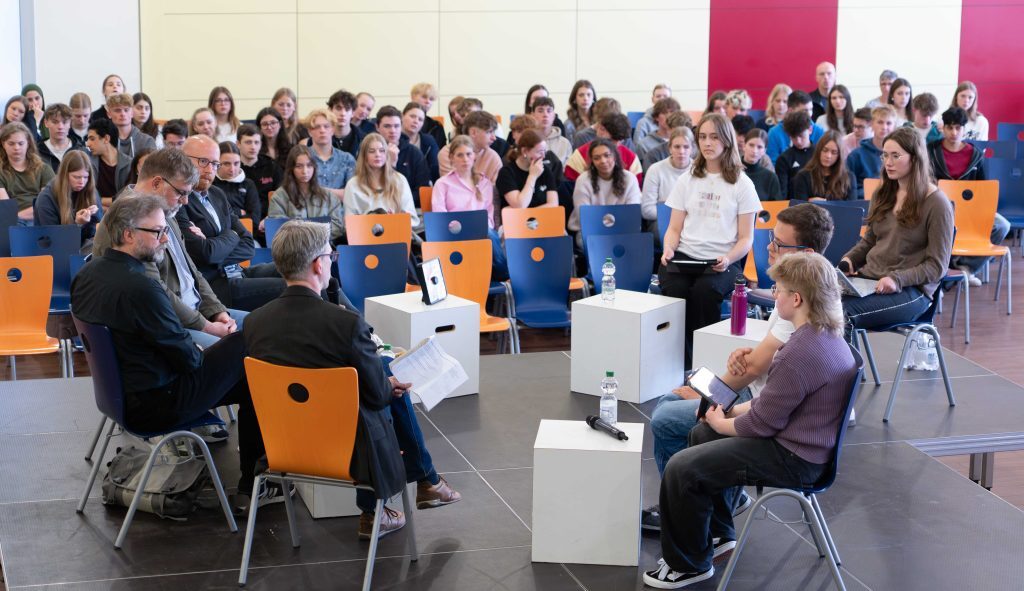


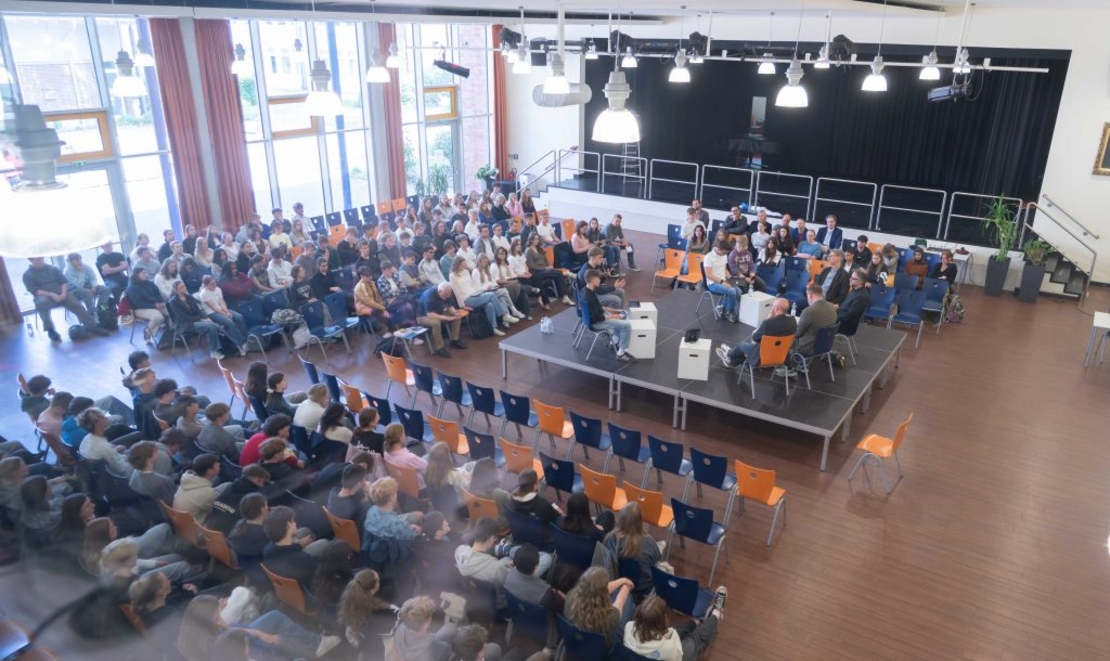
Mr Hardt (Director of the Lingen District Court), Dr Weitkamp (Head of the Esterwegen Memorial), Prof. Dr Rass (University of Osnabrück) and Mr Schnittker (Head of Ems-Vechte-Welle) impressively demonstrated why it is still important today – or especially today – to engage with this period. They answered questions from eleventh and twelfth grade students, which were posed by enthusiastic moderators.
In times when right-wing thinking is gaining momentum again, it is crucial to be aware of how cruel the Nazi regime actually was. But the Second World War ended 80 years ago – most of the contemporary witnesses have passed away. So how can we keep the memory alive today?
Mr Rass replied: "No one would ask: Where are the contemporary witnesses from the Middle Ages?" Although it is tragic that contemporary witnesses are dying, from a historical perspective it is quite normal. Mr Weitkamp emphasised that this makes it all the more important for us as a society to preserve their experiences and pass on their stories. It is now up to us to continually engage with the past.
In this context, Mr Weitkamp warned that watching five TikToks does not make you a history expert. Social media offers enormous potential – it can spark interest and facilitate access to complex topics. However, according to Mr Rass, it should only ever be the starting point, not the end of the discussion. In the best case scenario, they would lead to more in-depth engagement – for example, through blogs, books or visits to memorial sites.
The importance of such memorial sites was particularly emphasised by the director of the Esterwegen Memorial, Mr Weitkamp. He reported on a moving visit by a British couple who had recently mourned there – the grandfather had died here as a so-called Nacht-und-Nebel prisoner. Memorial sites are not only historical places – for relatives, they are often the last tangible traces of their family history.
The moderator began the final round of questions with a quote from Holocaust survivor Margot Friedländer: "Don't look at what divides you. Look at what unites you. Be human. Be reasonable." This led to the question: How can we succeed in being reasonable, as Ms Friedländer demands?
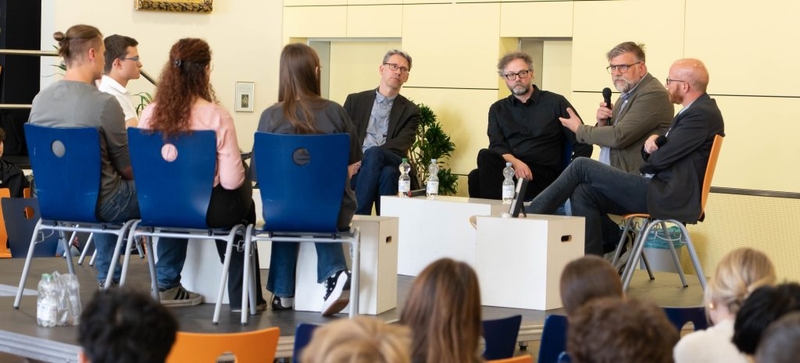
Each of those present gave their own definition – and yet they were all united by one thought: something inhuman cannot be reasonable. However, it is not only crucial to recognise this, but also to act accordingly – to act humanely.
For even if we bear no guilt for the crimes of the past, we bear responsibility for what happens in the future.
Text: Len Sarrazin (Year 13), photos: Stefan Kemmer.
The questions from Years 11 and 12 were evaluated, revised and compiled by the editorial team, which included:
Melina Bimm, Antonia Krieger, Anna Lammers, Jakob Neubert, Emily Schenk (all Year 11) and
Merle Altmeppen, Jana Dillmann, Selma Holle, Bente Koops, Jakob Sturm, Jonathan Teupen, Anna-Maria Vehr (all Year 12).
Under the title "80 YEARS LATER – WITH HISTORY FOR DEMOCRACY": PANEL DISCUSSION AT THE GEORGIANUM, the Chair of Contemporary History and Historical Migration Research (NGHM) published a positive summary of the same panel discussion in the following blog post: https://nghm.hypotheses.org/35707